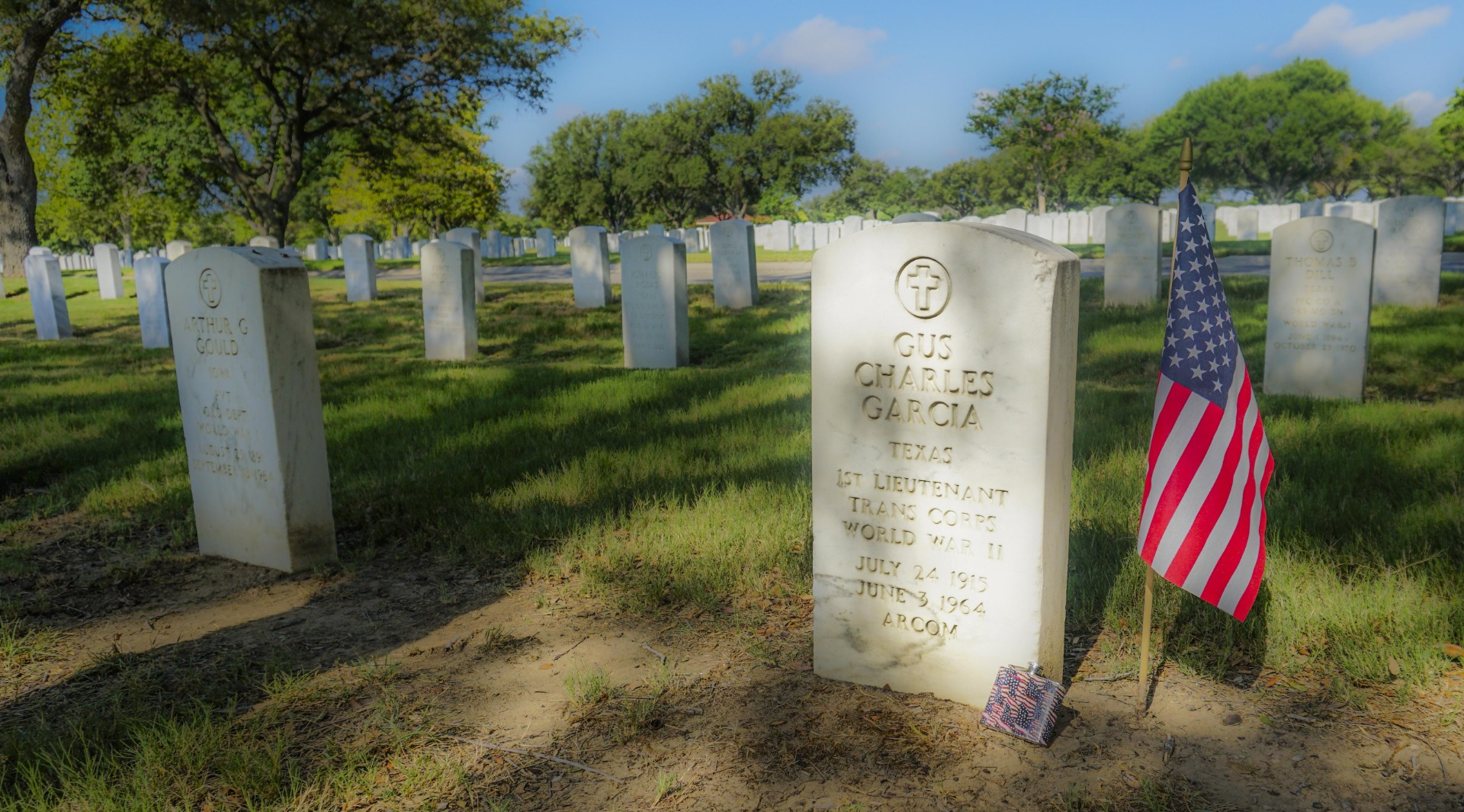
About Gus
The sharpest legal mind there ever was
Gus was born in Laredo, Texas, on July 27, 1915, moved to San Antonio at an early age and made San Antonio his home until his death at the Old Farmers Market, now El Mercado.
Gus was and is the most beloved and known Mexican American lawyer and civil rights activist of the twentieth century. During his time in San Antonio, Gus was the most prolific civil rights attorney. He filed and won two of the most important cases that changed the status quo that existed and allowed for Mexican American citizens to be legally discriminated against in Texas.
1948
Delgado v. Bastrop ISD
In 1948, Gus filed and won Delgado v. Bastrop ISD. This landmark case started the end of education segregation against Mexican American children in Texas. In the 1940s, too many Mexican Americans in Texas attended segregated schools. Mexican Americans in Texas were kept out of restaurants, theaters and public swimming pools. There were signs all over that said, “No Mexicans allowed.” Few Mexican Americans served on juries in Texas.
1954
Hernandez v. Texas
In 1954, Gus was lead lawyer in Hernandez v. Texas. For the first time in the history of the U.S. Supreme Court, an all Mexican American legal team argued a case before them. Gus, along with other Mexican American attorneys Carlos Cadena, James DeAnda and Johnny Herrera, along with major support from attorney Chris Alderete and former San Antonio mayor and U.S. congressman Maury Maverick, argued the case for defendant Pete Hernandez.
Gus argued that Mexican Americans and all Latinos in Texas were being treated as a class apart. In his argument before the U.S. Supreme Court, Gus gave his most famous oratory presentation that so moved the justices and Chief Justice Earl Warren, who reportedly commented:
“Counselor, I am so impressed with your eloquence and your preparation, that I will ask you to disregard the light and continue with your presentation.”
He allowed Gus an extra 16 minutes to conclude his presentation: the first time allowed in the history of the U.S. Supreme Court. The justices agreed unanimously and ruled in Hernandez’s favor. This case gave Mexican Americans and all Latinos protection under the 14th Amendment.
A legacy for one lifetime
Gus was so gifted that he left a legacy that is unimaginable for any one man to accomplish in one lifetime.
- 1932
At age 17 in 1932, Gus was Thomas Jefferson High School valedictorian in a mostly all Anglo student body. Another Mexican American at Jefferson was Henry B. Gonzalez.
- 1936 & 1938
University of Texas graduate with honors, 1936 (bachelor’s degree), and law degree, 1938.
- 1936–1938
As a student at the University of Texas in 1936–1938, Gus was the debate team captain and debated Harvard and John F. Kennedy.
- UT years
While a student at the University of Texas, Gus became friends with Lady Bird Johnson, later wife of President Lyndon B. Johnson, John Connally, later governor of Texas, and President John F. Kennedy.
- 1938 & 1941
Gus was an assistant attorney for Bexar County in 1938 and the City of San Antonio in 1941.
- 1939–1940
Gus was legal advisor to LULAC in 1939–40.
- 1941–1946
U.S. Army, 1941–1946.
- 1945
In 1945, President Harry S Truman asked Gus to participate in the founding of the United Nations in San Francisco, as part of the U.S. legal team.
- 1947
In April 1947, Gus filed suit against Cuero ISD in Cuero, Texas, to force closure of the Mexican school.
- 1948
Gus filed and won Delgado v. Bastrop, 1948. Made segregation of Mexican Americans illegal.
- 1948
Gus was the first Mexican American elected to the San Antonio ISD, in 1948.
- 1949
Gus was the lawyer for Felix Longoria in 1949, in what is known as the Felix Longoria Affair, for discrimination against Mexican American soldiers in Three Rivers, Texas.
- 1949
Gus helped in contract negotiations in the Bracero Program, 1949. Helped Mexican farm workers to legally work in the U.S.
- 1949
In 1949, Gus helped revise the LULAC constitution to allow non-Mexican Americans to join.
- 1950
On May 8, 1950, Gus Garcia appeared before the State Board of Education to seek desegregation enforcement. Too many school districts in Texas were not complying with Delgado v. Bastrop.
- 1951–1952
Gus was legal advisor to the American G.I. Forum, 1951–1952.
- 1952
Gus Garcia spoke at the Education Session of the Third National Conference of the United States National Commission for UNESCO in New York on January 29, 1952, on education, especially for minorities in the United States.
- 1952
In 1952, the University of Texas Alba Club named Gus “Latin of the Year.”
- 1954
Lead lawyer in Hernandez v. Texas, 1954. Gave not only Mexican Americans but also all Latinos protection under the 14th Amendment as a class apart.